Subtitling ¡Vámonos, Bárbara! (Bárbara, Let’s Go!, Bartolomé 1978): Film History and Feminism
Today at Mediático we are particularly delighted to publish a post by Sally Faulkner and Eliana Maestri which characterizes the process of subtitling Cecilia Bartolomé’s ¡Vámonos, Bárbara! as a “feminist act of recovery” and enumerates the challenges they faced as part of a team (from the universities of Exeter, Cambridge and Kent including Núria Triana-Toribio, Jara Fernández-Meneses and Rachel Beaney) translating the 1978 Spanish film into 2023 British English subtitles. Part of a broader project, ‘Subtitling World Cinema’, ¡Vámonos, Bárbara! was one of several unsubtitled world cinema films taken on by the project that had previously been inaccessible to Anglophone audiences. The subtiting of ¡Vámonos, Bárbara! was also supported by an Arts and Humanities Research Council Grant ‘Invisibles e insumisas / Invisíveis e insubmissas: Leading Women in Portuguese and Spanish Cinema and Television, 1970-1980’, which began at the University of Exeter (2021-24) and transferred to the University of Cambridge (2024-26). Professor Sally Faulkner is 1933 Professor of Spanish at the University of Cambridge and author of The Cinema of Cecilia Bartolomé: Feminism and Francoism (2024). Dr Eliana Maestri is Senior Lecturer in Translation Studies and Director of the Centre for Translating Cultures, University of Exeter and the author of Translating the Female Self Across Cultures: mothers and daughters in autobiographical narratives (2018).
Subtitling ¡Vámonos, Bárbara! (Bárbara, Let’s Go!, Bartolomé 1978): Film History and Feminism
by Sally Faulkner and Eliana Maestri
In 2018, with the help of an initial grant from the University of Exeter, the authors set up a Digital Humanities project, ‘Subtitling World Cinema’ with Will Higbee, Danielle Hipkins and Ting Guo (all University of Exeter at the time) to subtitle into English examples of world cinema that were at that point inaccessible to Anglophone audiences as they had never been subtitled or dubbed. The first project was Fernando Fernán Gómez’s El mundo sigue (Life Goes On) (1963 / 1965 / 2015), which although subtitled by festivals that screened it on the film’s 50 year anniversary, was released on DVD without subtitles in 2015.[i] Securing copyright from the son of the film’s original producer, Juan Estelrich, we set up a team of University of Exeter MA Translation Studies students to subtitle (Matthew Burden and Rebecca Ellerker), and, with the support of Exeter’s Digital Humanities team, were able to screen the film publicly in Exeter (Exeter Phoenix, 13 June 2019) and stream it on the project website.[ii]
As Sally Faulkner was researching her book The Cinema of Cecilia Bartolomé: Feminism and Francoism (2024), she discovered that fully none of this important feminist director’s work had ever been subtitled. This lack of subtitling was in fact just one example of the wider difficulties Bartolomé faced throughout her career. Her stunning Film School work was made against the odds (Figure 1). First, the post-production of her musical-comedy short film about women’s lack of access to contraception, Carmen de Carabanchel (Carmen of Carabanchel, 1965), was delayed by the School, then her teachers there failed it, and she had to repeat the year (Faulkner 2024, 27-36). Second, and worse still, her final-year assessment piece, Margarita y el lobo (Margarita and the Wolf, 1969) was passed, but then censored and banned by the Director of the Film School himself (Juan Julio Baena): its existence today is thanks to the quick thinking of producer Juan Huarte who smuggled a copy out (Calpena 2022). These two films never made it to Spanish screens, let alone international ones. Our project subtitled them, premièred them at the Manchester HOME cinema ¡Viva! Spanish and Latin American film festival over 25-26 March 2023, and the Spanish Film Archives now have the subtitling files to add to their digital release of this work on their new platform Filmfo.
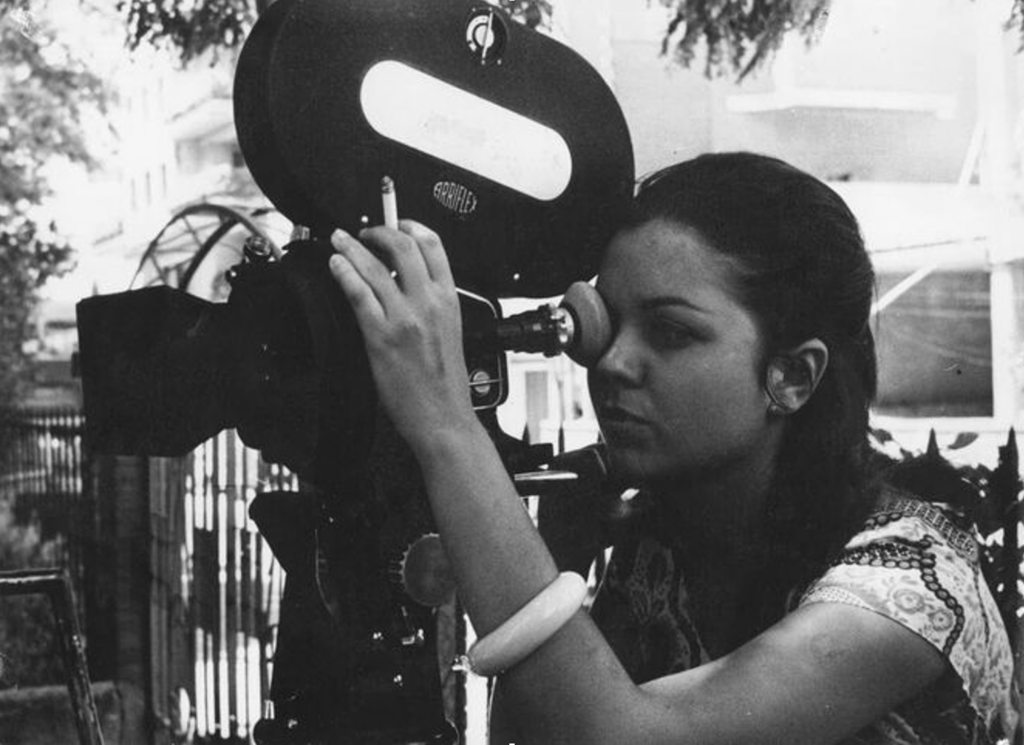
Figure 1: Cecilia Bartolomé at Film School
After her Film School Margarita y el lobo was banned, Bartolomé was black-listed by the regime and unable to make her first feature until 1978, after Franco’s death, when she was commissioned by Alfredo Matas to make a Spanish version of Martin Scorsese’s Alice Doesn’t Live Here Anymore (1974). In ¡Vámonos, Bárbara! Bartolomé takes the theme of marital separation and the mother-child relationship from Scorsese, but in her hands it becomes a raucous, feminist road movie-comedy that homes in on the mother-daughter relationship and ends with the emphatic rejection of a second marriage in all but name. ‘Al fin solas’ (Alone at last) Amparo Soler Leal’s Ana says to daughter Bárbara (Cristina Álvarez) (Figure 2) in an echo across times and across texts from the last words of Margarita in her 1969 film, ‘por fin sola’ (Alone at last), itself an adaptation of the final words of Cristiane Rochefort’s Les Stances à Sophie (1963), on which it is based: ‘Enfin seule’ (Alone at last). ¡Vámonos, Bárbara! was released and distributed in Madrid (in a dubbed Spanish version) and Barcelona (in a dubbed Catalan version). The Catalan version was made by producer Matas without Bartolomé’s consent and was the nail in the coffin of their collaboration. Once Matas had the subsidy for the Catalan version he neglected any further distribution nationally, let alone internationally (Faulkner 2024, 215-16). A film hailed as ‘Spain’s first feminist film’ thus slipped into obscurity in Spain, and was never known outside Spain.[iii]
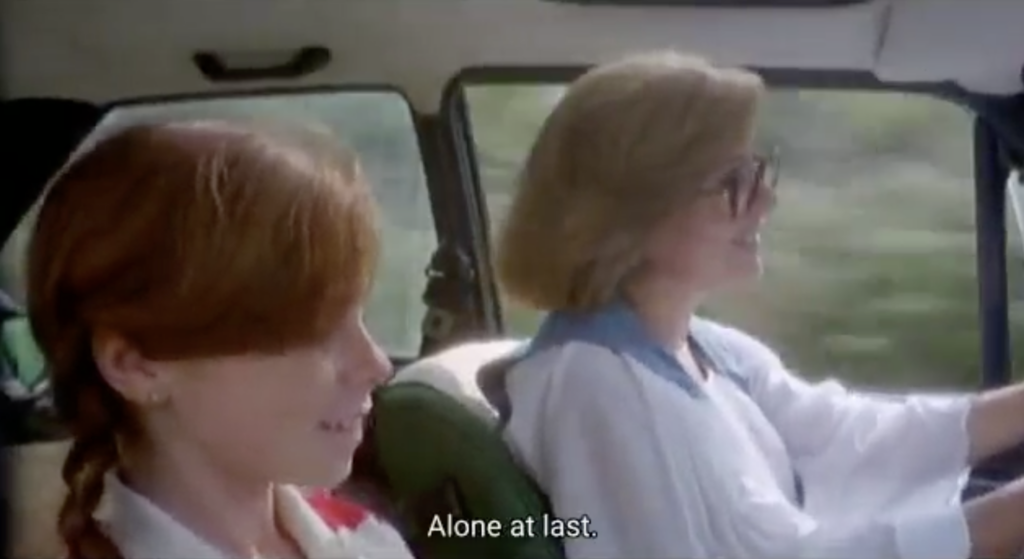
Figure 2: Bárbara (Cristina Álvarez) and Ana (Amparo Soler Leal) in Cecilia Bartolomé’s ¡Vámonos, Bárbara! (1978).
Subtitling ¡Vámonos, Bárbara! thus became a vital act of feminist recovery as part of the subtitling project’s wider goals to give Anglophone audiences access to world cinema that was never subtitled into English. We secured copyright permission for the film’s première outside Spain (some 35 years after it was made) at the Manchester ¡Viva! Festival on 25 March 2023, followed by a screening at Exeter Phoenix cinema on 25 May 2023 (Figure 3), and have subsequenty screened it in educational contexts at the Universities of Exeter and Cambridge (Peterhouse). This blog post seeks to share our overall approach to setting up the team and establishing the feminist strategy for subtitling the film, then discusses some specific examples of the challenges of rendering the Spanish language used in a 1978 film into 2023 British English subtitles.
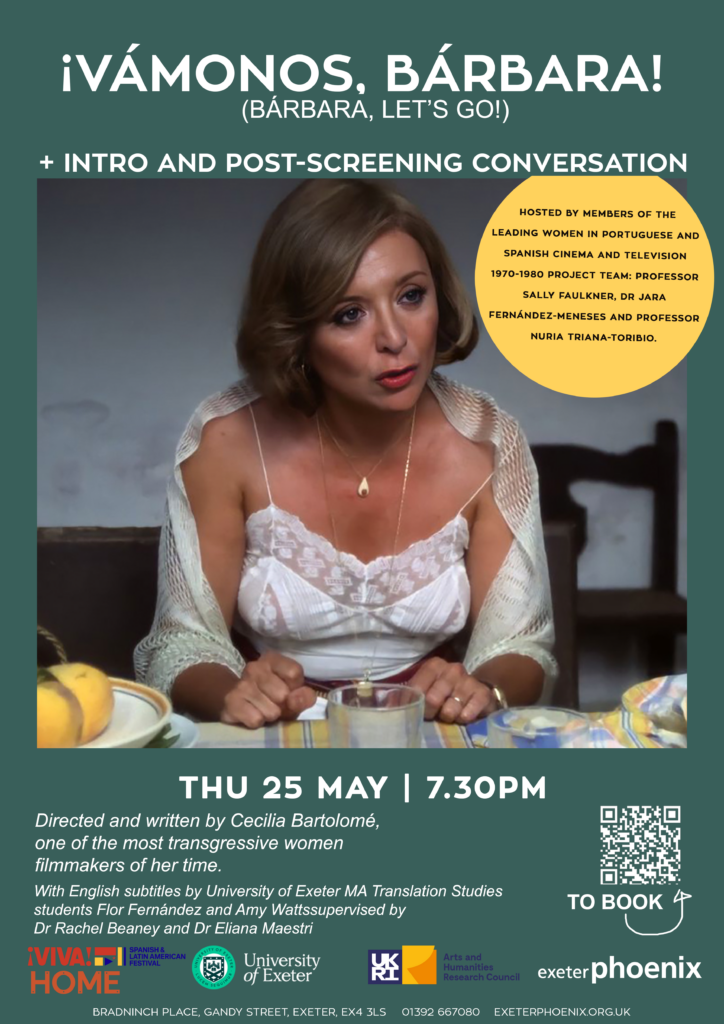
Figure 3: Poster for Cecilia Bartolomé’s ¡Vámonos, Bárbara! (1978) screening at Exeter Phoenix.
Subtitling ¡Vámonos, Bárbara! is a collaboration: it combines Faulkner’s knowledge of Spanish film history and feminism with Eliana Maestri’s specialism in translation, subtitling and feminism. We worked on the project with two MA students of Translation Studies at the University of Exeter, Flor Fernández and Amy Watts, whom we paid from the further grant Faulkner won to support this work: the Arts and Humanities Research Council Grant ‘Invisibles e insumisas / Invisíveis e insubmissas: Leading Women in Portuguese and Spanish Cinema and Television, 1970-1980’, which began at the University of Exeter (2021-24) and transferred to the University of Cambridge (2024-26). In addition, co-investigator on this grant, Núria Triana-Toribio (University of Kent), one of its post-doctoral research assistants, Jara Fernández-Meneses (now University of Southampton) and its graduate research assistant, Rachel Beaney, helped with the processes of transcription, translation, and adaptation to standard subtitle length. We also collaborated with University of Exeter Digital Humanities colleagues on the use of software Aegisub to create the subtitle files, then added them to the film.
Our approach to subtitling, and thus our guidance in the supervision of the students, is articulated in the subtitle of Faulkner’s book ‘feminism and Francoism’. First, we understood subtitling to be a feminist act of recovery, one in which, to adapt Barbara Godard’s felicitous phrase, we ‘womanhandled’ the text paying tribute to how ‘women are writing their way into subjective agency’ (1990, 22) and how translators can become well-informed and reflective participants in the production of meaning. Our feminist decisions in the subtitling include, for example, translating directly the descriptions of gender violence and post-partum physical pain, even if such directness makes the subtitles wordier (we discuss specific examples below).
Furthermore, with regards both Bartolomé and her collaborators’ work in the 1970s, and the work of our students today, we endeavoured to adopt a feminist ethics of ‘care’. As explained in Maestri’s study on translation and/as advocacy (2025), translation practices informed by feminist acts of care heighten the attention we pay to detail, the other and the relational aspect of the work we do. Inspired, for example, by ecofeminist Mary Phillips and her articulation of these ethics in the context of environmentalism, Maestri demonstrates how ‘care-full’ work (2025) can support not only our green citizenship but also our imagination and relational disposition to love and respect others in translation. We applied this care-imbued disposition to teach our students how to advocate for the other and the vulnerable in translation and appreciate the emotional world locked in every character with care and respect. We thus paid especial attention to the question of affect, both the affect arising from the decisions made by Bartolomé and co-creators – especially scriptwriters and actors – in the 1970s, and the affect arising from subtitling decisions in the 2020s. For Godard, affect is one of the distinctive qualities of feminist discourse, which constitutes an ‘écriture a deux’ (Suzanne Lamy quoted in Godard 1990, 21), a mode of writing predisposed to embracing the emotional dimension of the other. While referring to the work carried out by Canadian poet and novelist Nicole Brossard, Godard stresses how important it is to make female experiences visible and known to the dominant discourse. This ‘complex process’ entails the inscription of ‘unrecorded emotion’ which – when carefully handled – undergoes ‘a double movement of translation where the emotion is first voiced and heard, then “translated” and acted upon’ (Godard 1990, 22). Co-producing subtitles was a way for us to extend this relational, and ‘care-full’ practice centred on the emotional and affective dimension of the feminine, the other and the vulnerable. Each of us heeded Godard’s call to be ‘an active participant in the creation of meaning, who advances a conditional analysis’ (Godard 1990, 26).
With ‘Francoism’ we refer to the imperative to be sensitive to, and accurate with, the historical context in which the film was made, a Spain that was emerging from dictatorship. 1977, when the film was shot, and 1978, when it was released, were the years of a very particular moment of Transition from dictatorship to democracy in Spain. Of course, the dictator had died (of natural causes) in 1975. Film censorship was abolished in December 1977, after the film was shot. Thus, you can see that Bartolomé spoofs the contemporary trend of soft-porn cinema that anticipated this abolition, the destape, for example in the amusingly unnecessary sex and nudity of the pre-credit sequence, and in Ana’s balcony miopic ‘mantón de manila’ (manila shawl) dance. Furthermore, negotiations for the new democratic constitution (finally approved in October 1978) were under way. As Ana’s bed-ridden, chain-smoking and disapproving mother describes her daughter’s proposed separation from her husband Carlos: ‘El país, patas arriba. Hasta tú te estás contagiando’ (rendered in our subtitles as ‘The country is upside down. Even you’re getting infected by it all’).[iv]
One of the challenges to the project was thus insisting on this deep and ‘care-full’ sensitivity to historical context. ‘Separación matrimonial’ could not be rendered as ‘divorce’, as in the first draft of the subtitles, as lack of legal divorce was precisely Bartolomé’s point (in the end Ana’s initial request to Carlos ‘he pensado que debemos separarnos’ was colloquially rendered as ‘I’ve been thinking we should break up’). Among many other things, ¡Vámonos, Bárbara! is part of the social activism that preceded the legislative act of re-legalizing divorce in 1981 (it had been legal from 1932-39 during the Second Republic [1931-39], which Franco’s Nationalists overthrew by Civil war [1936-39]). More difficult to capture was Bartolomé’s specific joke about the contemporary legal negotiations concerning the Transition to democracy. When, at the joyous ending of the film, mother and daughter ditch Ana’s new boyfriend Iván (the terrible), who is proving to be ‘husband’ Carlos take two (played by Iván Tubau, also a writer and academic), the two have a discussion about ‘hacer pactos’. ‘Vamos a hacer otro pacto’ (‘We’re going to make another pact’) proposes Bárbara (Figure 4), to which Ana responds ‘Ni hablar, que luego no lo cumplimos y nos cabreamos cada vez que uno lo rompe’ (‘No way, because we won’t stick to it and we get angry when the other breaks it’). This triggers a gleeful ‘Pero mamá, ¡los pactos están para romperlos! Si no, no tiene gracia’ (‘But Mum, pacts are made to be broken! Otherwise, they’re no fun!’) from the girl, and a shocked look from her mother (see Figure 5). We therefore rendered ‘hacer pactos’ as ‘making pacts’, keeping the ‘pact’ of the original, rather than using the colloquially preferable ‘deal’, and thereby retaining an important link to contemporary politics for the audience. Some members of the audience may have known that the film was shot and released in the context of the legal Moncloa Pacts of 1977, Constitutional Pact of 1977-78, or wider social Pact of Forgetting, all of which were critical steps in the path to the signing of the democratic Constitution in 1978. Other members of the audience might have wondered about ‘pact’, then perhaps gone on to discover these details of the context. Sacrificing the idiomatic ‘deal’ for ‘pact’ was thus the right decision overall.
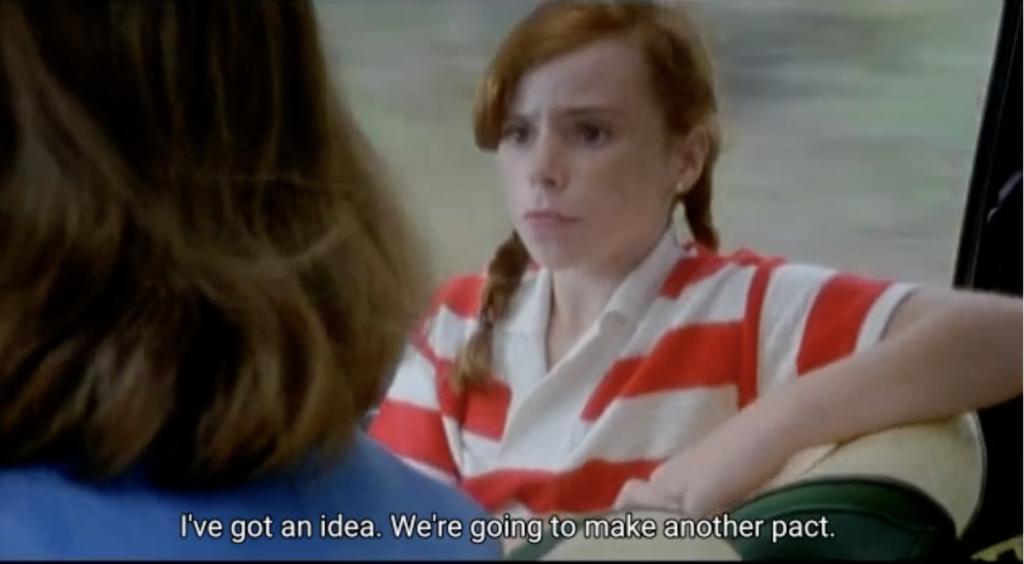
Figure 4: Bárbara (Cristina Álvarez) in Cecilia Bartolomé’s ¡Vámonos, Bárbara! (1978)
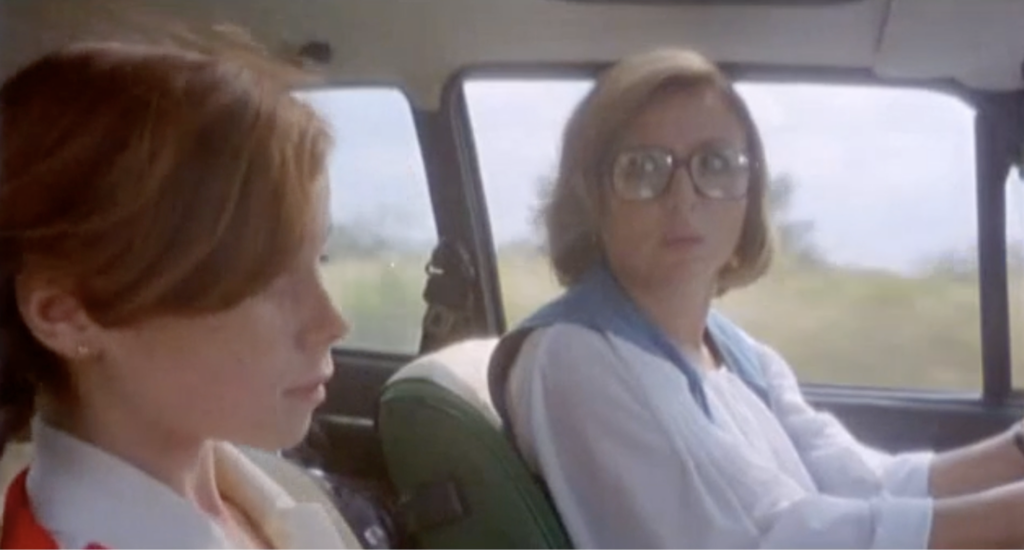
Figure 5: Bárbara (Cristina Álvarez) and Ana (Amparo Soler Leal) in Cecilia Bartolomé’s ¡Vámonos, Bárbara! (1978)
Particular care was taken over rendering the multiple conversations between women in the film. Raw black pudding-eating Aunt Remedios, with her traditional farm – complete with aggressive dog, and broken-down plough – nestled in amongst the tourist flats of Tarragona, speaks the language of her generation. Encouraging Ana to return to Carlos, for example, she uses idiomatic phrases like ‘Un poquito de mano izquierda, hija, en la vida hay que saber ceder’, which the subtitles successfully render as ‘Smooth things over, dear. In life one must know when to give in’. These comments were layered with Aunt Remedios’s other colourful expletives like ‘¡Manda cojones!’, which we had as the less graphic ‘Goodness me!’, a phrase that is less colourful, but one we deemed age-appropriate.
Among Ana’s peers are the friends from school that she meets at the beach. They vociferously complain among themselves about their husbands’ lack of care in sexual relations, and over drinks at the beach bar, their conversations include idiomatic and also physically graphic details. ‘Te buscas una puta,’ one of the women reveals she has told her husband, ‘que yo no quiero más barrigas’, which we had as ‘Get yourself a whore. But no more buns in the oven for me’. Another understandably complains about the pain of penetrative vaginal sex post-partum, ‘No puedes imaginarte qué dolores. Con la matriz descolgada! Y él, dale que te pego’. Written rather than spoken, these comments are shocking in the subtitles ‘You can’t imagine the pain. With my uterus hanging loose! And he just keeps on going!’, but we felt this tone was justified to capture this history of female physical suffering after multiple childbirths. To all the complaints about the husbands like ‘Son unos cerdos’ (‘They’re such pigs’), Ana asks ‘Y ¿por qué demonios no los mandáis todos a tomar por el culo?’. Here we felt a swear word was necessary, though, again, the impact of the written word is stronger than the spoke. Thus we had ‘Why don’t you just tell them all to fuck off, then?’
The uproarious sequence on the bus, apparently based on a scene Bartolomé herself witnessed (Faulkner 2024, 88), where a group of older women criticize their husbands’ sexual behaviour (and by implication the lack of contraception in Spain in general) required careful attention. The first older woman, who describes how many children she has (or rather: had to have) ‘Once tuve yo, y catorce mi madre’ (‘I had eleven [children], my mother fourteen’), unleashes a diatribe against the bus driver, who, for his part, defends the men. Again, handling of phrases that carry less impact when spoken than when written had to be carefully thought through. Another woman comments ‘que van a lo suyo, y a una, ¡que le parta un rayo!’, which we rendered as the less dramatic ‘They just care about themselves, not us!’. When the first complainant spits out ‘habrá que cortársela’ in fury, our version was ‘they should get it [their penis] chopped off’. Perhaps this translation is too dramatic as in written language the phrase is much more startling.
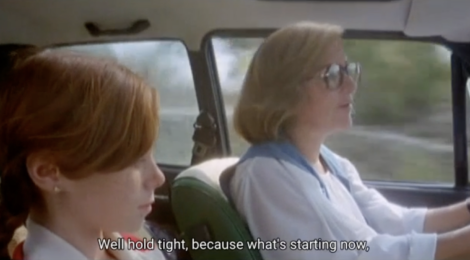
Source of most joy to the both the students and the academic supervising team was rendering the expressions and interactions between Bárbara and her mother Ana, a relationship between two generations of women that actually felicitously matched the relationship between the older female researchers of the project, and younger female student subtitlers. Thus, at the end of the film, Bárbara approvingly remarks ‘¡Mamá, eres la bomba!’ (Mum, you crack me up!), and of Iván, ‘¡Le has dejado tirado!’ (You’ve left him stranded!) and ‘Pobre. Pero, ¡es que era un coñazo!’ (Poor guy. But he was a pain in the arse!). Ana, meanwhile, having explored her new-found independence throughout the film, speaks of the future to Bárbara thus: ‘Pues ¡agárrate, que la [aventura] que empieza ahora promete ser cosa fina!’ (‘Well hold tight, because [the adventure that’s] starting now promises to be something else!’) (Figures 6 and 7)
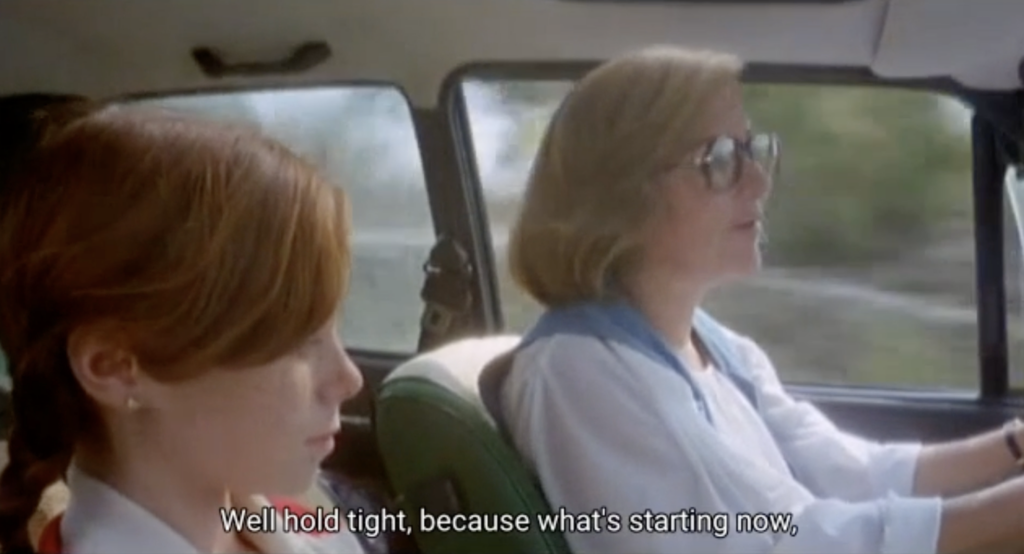
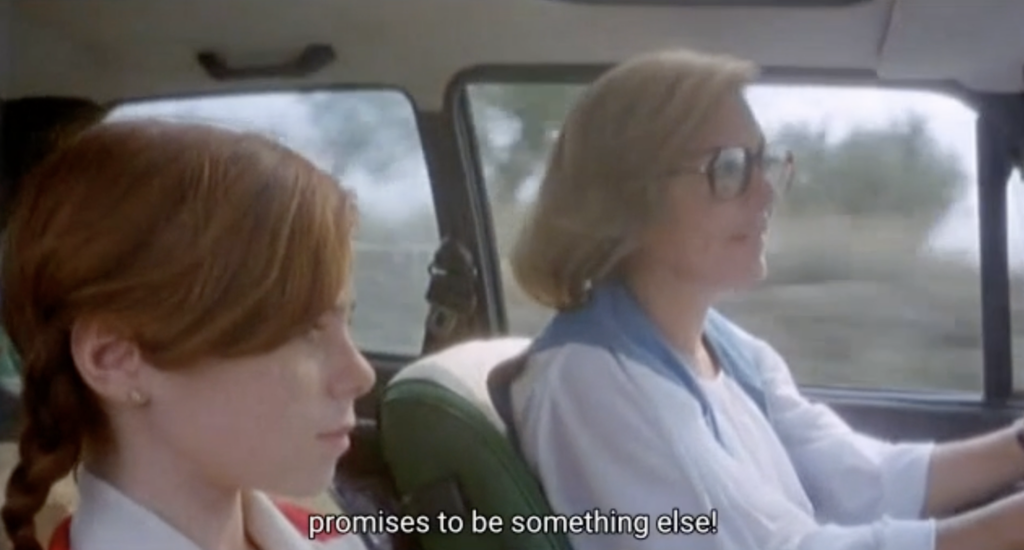
Figures 6 and 7: Bárbara (Cristina Álvarez) and Ana (Amparo Soler Leal) in Cecilia Bartolomé’s ¡Vámonos, Bárbara! (1978)
However, we perhaps need further to improve our subtitles at the start of the film, when Ana connects her decision to leave Carlos to her age, and wanting finally to live her own life, rather than giving up and slipping into middle and old age. The translation of ‘Ya me había resignado a vivir como una mujer acabada, como una señora, vamos’, given this importance of age and generational change, was therefore crucial. We chose ‘I had already settled for living like a woman who life had finished with. Like an old lady, I mean.’ While ‘old lady’ works for ‘señora’ in the context, we ended up spelling out ‘mujer acabada’ as a ‘woman who life had finished with’ (Figure 8) which is rather literal, wordy and not conversational. ‘Over the hill’[v] or ‘past it’ may have been better, though both lose the specific female gendering and possible reference to the menopause that is contained in the Spanish.
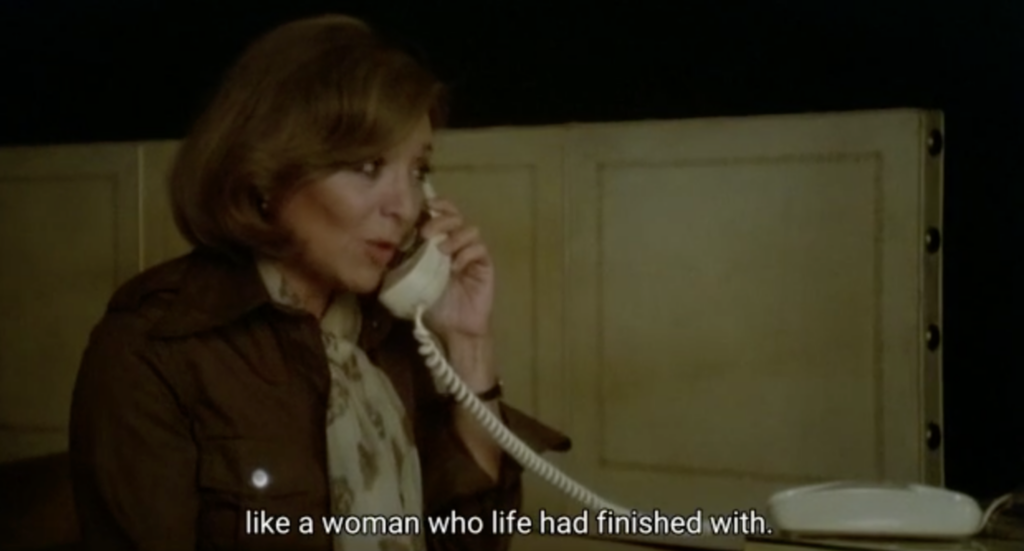
Figure 8: Ana (Amparo Soler Leal) in Cecilia Bartolomé’s ¡Vámonos, Bárbara! (1978)
A final challenge was to take sensitive care of the language of the queer characters of the film, Andreu (José Lifante) and Curro (Ernesto Martín). Andreu is a middle-class antiques dealer, a profession that may seem terribly clichéd for a gay character today, but his inclusion as a supportive friend to Ana was ground-breaking in its moment. When translating Ana’s kindly meant, but rather clumsily phrased ‘los que son como tú’, we thought ‘men who are like you’ worked. However, Andreu’s description of himself and the homosexual community as ‘Nosotros somos basura’ was tricky.[vi] We wonder if the phrase we chose, ‘We’re dirtbags’, is too homophobic (though Andreu is at this point condemning homophobia) and might be improved upon, perhaps using ‘trash’.[vii] But we felt scriptwriters Bartolomé, Sara Azcárate and Concha Romero’s opted for Andreu’ use of this word with negative connotations precisely to condemn homophobia. Respecting the scriptwriters’ choice and Lifante’s performance, and handling both with care, meant having to make this difficult choice.
Curro, meanwhile, is a poor immigrant worker from rural Andalusia (though the description of these workers as ‘xarnego’ [in Catalan] or ‘charnego’ [in Castilian] is not used in the film) who prostitutes himself with Andreu. Iván’s hostile attitude towards him thus may be either racist or homophobic (or both). While it was impossible to render his strong Andalusian accent in the subtitles, we took care over his brief description of his life story to Ana, including the phrase ‘yo tengo una novia en el pueblo’ (I have a girlfriend in my village). This was tricky as it took an attuned native speaker to hear the difference between ‘novia’ and ‘novio’ in his spoken, accented speech. Correcting the initial mistake of the erroneously understood ‘novio’ to ‘novia’ was absolutely critical to convey his story of poverty, internal migration and economic struggle in contemporary Spain. It also points to a wider critique that Jorge Pérez has spelled out in his discussion of the film. On the one hand, Ana and Andreu’s friendship portrays a positive alliance between ‘feminist issues’ and ‘social discrimination against gays and lesbians’. On the other, ‘the film lucidly exposes social injustices […]: while wealthy women could transform themselves on the open road, low-class homosexuals were denied access to this liberating space and remained excluded legally and socially in the early years of post-Franco Spain’ (2008, 220).
In conclusion, such has been the response to the public screenings of ¡Vámonos, Bárbara! so far that we are inspired to screen it further (we are currently unable to secure the copyright to stream it). For example, we were delighted to read that an anonymous member of the audience at our Manchester première had taken the trouble to post a review on the International Movie Database page. The piece is titled ‘I had already settled to live life like a woman whose life has already finished’, the very phrase that posed challenges to us in the subtitling. The member of the audience writes:
Excited to find an obscure title was going to be shown with English Subtitles, that I could not find anywhere online […] Fleeing from everything they have been surrounded by in their lives, the writers superbly lace the Road Movie adventure that Ana and Barbara share, (which includes a sly gay subtext when the mum and daughter meet Curro) with excellent comedy detours from the new faces they both meet, as Ana decides to let her daughter find a path in life, by letting Barbara go. (Anon. 2023)
All members of the subtitling team have been lucky enough to study languages earlier in their lives and careers. For those who have not been so lucky, for those who are English speakers but do not know Spanish, we continue to be inspired to subtitle further work, so that films like ¡Vámonos, Bárbara! are no longer lost to wider film and feminist histories.
References
Anon. 2023, ‘I had already settled to live life like a woman whose life has already finished’, https://www.imdb.com/title/tt0076901/reviews/?featured=rw9001767&ref_=tt_ururv_c_1_hd, consulted 23 March 2026.
Calpena, Ana, 2022, ‘Entrevista a Cecilia Bartolomé’, ‘Cecilia Bartolomé en al EOC’, Filmoteca Española. https://www.cultura.gob.es/dam/jcr:2853cdcb-22a8-452f-a165-c2d2d711670c/cecilia-bartolom–en-la-eoc—flores-en-la-sombra.pdf, consulted 23 March 2026.
Camporesi, Valeria, 2001, ‘El país patas arriba; hasta tú te estás contagiando: ¡Vámonos, Bárbara! y la Transición democrática’, in Josetxo Cerdán and Marina Díaz, eds, Cecilia Bartolomé: El encanto de la lógica, Madrid: Ocho y medio, 53-62.
Faulkner, Sally, 2024, The Cinema of Cecilia Bartolomé: Feminism and Francoism, Manchester: Manchester University Press
Faulkner, Sally, 2017, ‘Delayed Cinema and Feminist Discourse in Fernando Fernán-Gómez’s El mundo sigue (1963/1965/2015)’, Bulletin of Hispanic Studies, 94, 8, 831-45.
Fuentes, Gumer, 1978, ‘Review of ¡Vámonos, Bárbara!’, Vindicación Feminista, 23, 14.
Godard, Barbara, 1990, ‘Theorizing Feminist Discourse/Translation’, in Eva C. Karpinksi and Elena Basile, eds, Translation, Semiotics, and Feminism, London: Routledge, 19-27.
Maestri, Eliana, 2025, ‘Ecotranslation, ARTvocacy and Care: A Creative Response to Climate Change Communication’, Lingue e Linguaggi, 72, 135-166.
Pérez, Jorge, 2008, ‘Spanish Women Behind the Wheel: Gendering the Transition to Democracy in Vámonos, Bárbara’, Revista de Estudios Hispánicos, 42, 215-36.
Rochefort, Cristiane, 1963, Les Stances à Sophie, Paris: Éditions Bernard Grasset.
[i] The dates 1963, 1965 and 2015 are given as they are the date on which the film was made (1963), the date it received very limited distribution in Spain after being held up by censorship for two years (1965). The film was restored and re-released, including internationally, on its 50th anniversary in 2015, but the A contracorriente DVD version only included French subtitles. The film thus remained inaccessible to Anglophone audiences that could not attend its limited festival screenings in the UK. See Faulkner 2017.
[ii] The second project was the subtitling of Door to the Sky (Benlyazid 1989), as part of a wider project of restoration and digitization, led by Will Higbee and funded by the Arts and Humanities Research Council. The restored version of the film was premièred at the FNF (Moroccan National Film Festival) in Tangier, March 2020. Thirdly, under the supervision of Danielle Hipkins, MA in Translation Studies graduate Laura Connolly subtitled the previously un-subtitled Italian film Ambrogio (Labate 1992) for the Cineteca nazionale (Rome).
[iii] As Sally Faulkner discusses in The Cinema of Cecilia Bartolomé, this phrase was used for various films by Bartolomé, but it is important that it was tentatively labelled thus by Spain’s first feminist magazine, Vindicación Feminista, by the first feminist film reviewer writing in Spanish (to our knowledge), Gumer Fuentes (1978).
[iv] Valeria Camporesi takes this very phrase as the title of her article on the film (2001).
[v] With thanks to the audience for this suggestion following a screening of the film at Peterhouse, University of Cambridge, 21 March 2026.
[vi] Jorge Pérez notes that ‘The careful avoidance of the term “homosexual” […] is somewhat surprising if we take into account that by 1977 other Spanish films, such as Eloy de la Iglesia’s Los placeres ocultos (1976) had already featured openly gay characters and explicit homoeroticism’ (2008, 233 n. 10).
[vii] With thanks to Katie Brown for this suggestion following a screening of the film at the University of Exeter, 6 February 2026.