About Baltic
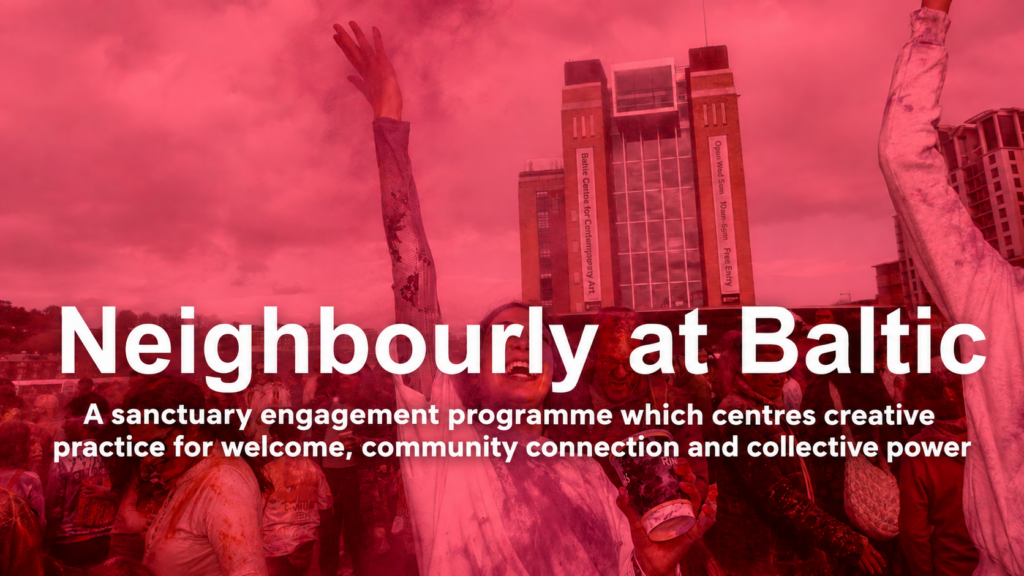
Baltic Centre for Contemporary Art in Gateshead hosts exhibitions, community gatherings, learning activities and festival events, with a broad range of collaborators across the North East of England.
About the project
Neighbourly is a multi-year, multi-layered sanctuary engagement programme, providing various and flexible entry points for people to engage with Baltic, from low-commitment participation to deep collaboration on creative projects and events.
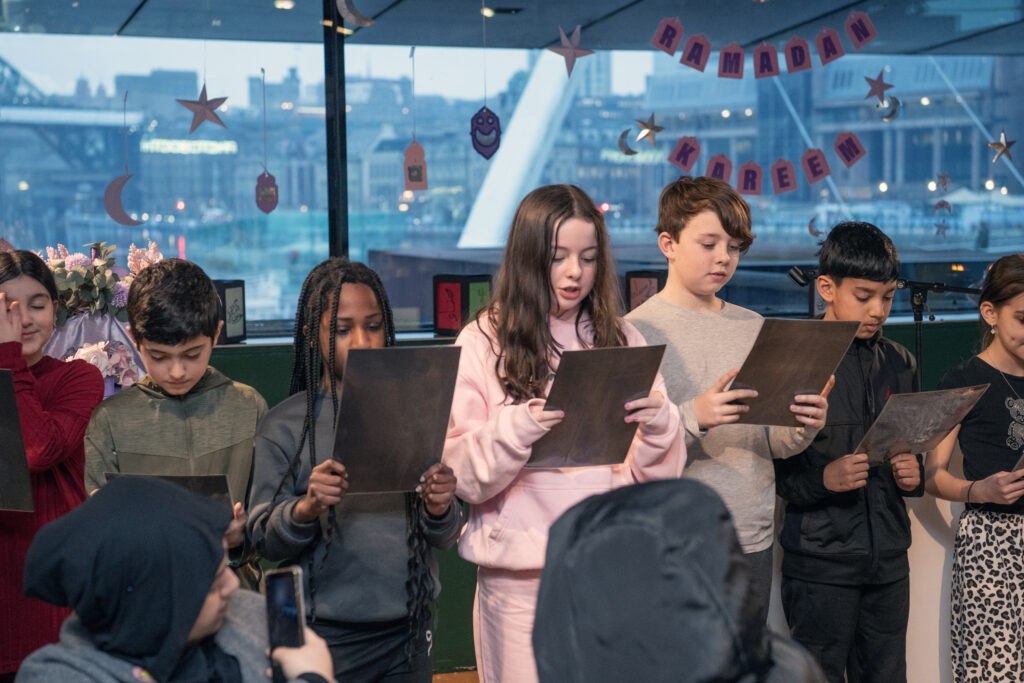
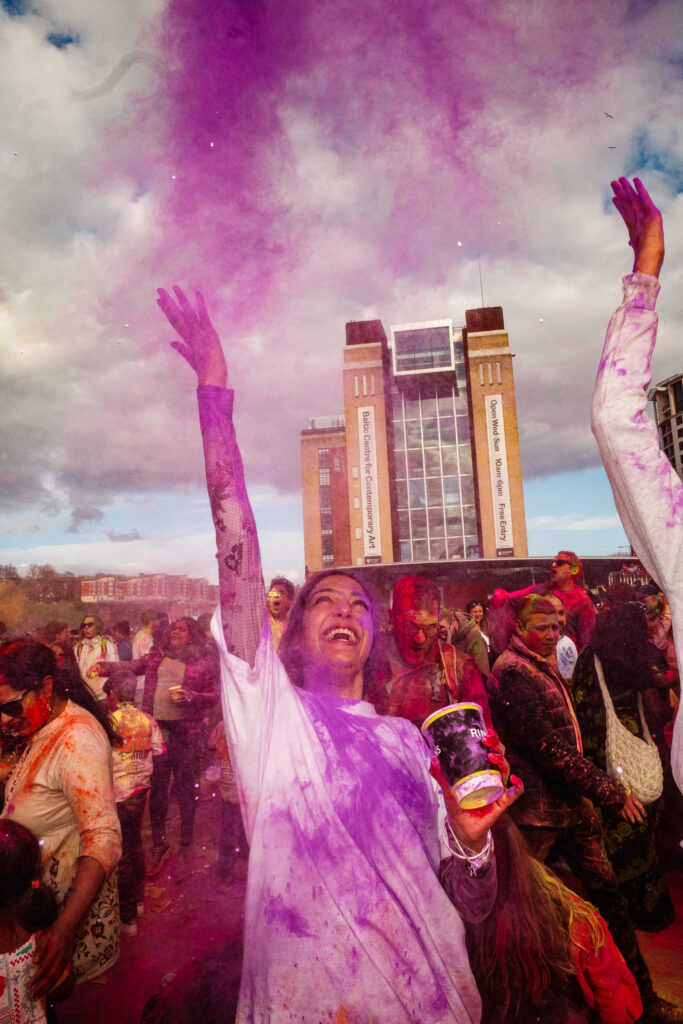
The programme includes artist development opportunities, volunteering, cultural sharing and faith-based events (Nowruz, Open Iftar and Holi), and a monthly Language Cafe.
The programme is integrated within a local asylum ecosystem, and national sanctuary movement. Structurally, it takes a programmatic, rather than project-based format, working holistically across Baltic to embed the work and subsequent learning within the institution.
Present across all strands of Neighbourly is a fostering of community togetherness, by creating social hubs for shared experiences, dialogue and connection – spaces in which we care and share with each other.
“It was really interesting to be part of the Codifying Refugee Participation workshops, and to have the opportunity to exchange with colleagues in other museums and galleries. The daily churn of work, meetings and delivery can be all-consuming – so having the space and opportunity to reflect with others was hugely important and useful. I was able to share thoughts, test thinking and approaches, explore shared challenges and develop practice – a process that has helped me bring further rigour to my work.” Annie Bedford, Communities Producer, Baltic Centre for Contemporary Art.
Project context
Baltic’s programme for communities asks: how can we be a good neighbour to the people around us? The organisation collaborates with community partners, individuals and artists based in Gateshead and further afield, working together on creative projects (or B. Locals), both within the arts centre, and across community settings.
Each B. Local has a different approach as we develop ideas and project structures alongside collaborators. Underpinning them all is creative practice rooted in relationship building which enables deep understanding of multiple lived experiences, mutual exchange, care and social justice.
B. Local Neighbourly was launched in 2019 to support people with forced migration experience in their rebuilding journeys and work towards an inclusive, welcoming region. Baltic staff believe that wherever people come from, we all have the right to feel safe, and in a context of anti-immigration narratives, we need to be loud, consistent and active in our work to create spaces of welcome. In early 2022 it became the first Gallery of Sanctuary in England, awarded by City of Sanctuary UK.
Arts participation, pedagogy and community can support people socially, creatively, therapeutically, and practically. In a context of Home Office reforms to the UK’s migration system, based on ‘control’, ‘removal’, and being ‘tough’, Neighbourly is an offer and a way of working based on welcome, warmth and neighbourly exchange.
Goals
Neighbourly is shared cups of tea, close listening, comfort and letters of support in challenging moments, openings for the recognition and celebration of faith and culture, introductions and connections, shared food, and creating alongside one another. The organisation views these moments of care, creativity and belonging as a right, and together with the power of exhibitions to transmit messages of welcome, a step in the direction of achieving justice for people who move and a fairer society for us all.
Baltic works alongside the City of Sanctuary UK and a local Culture and Sanctuary network to build a movement of welcome, supported by:
*Front Room (Front Room | Baltic Centre for Contemporary Art) and engagement programmes which create communities of care and togetherness;
*Creative platforms and practice which amplify migration stories and experiences, challenge dominant narratives and explore new ideas and possibilities;
*A whole-organisation approach to embed welcoming practices and ensure institutional learning and longevity
*The relational power and collective action of regional networks.
Participatory considerations and practices
Neighbourly nurtures every-day human relationships and champions our shared human rights.
While its ‘neighbourly spaces’ can be gentle, celebratory and light, its organisers are mindful of the dehumanising nature of the UK asylum system, and the reality for people navigating it, which is often characterised by precarity and hostility.
Feeling at home is deeply personal, and warrants reflection on the barriers, practical, emotional and structural, which combine to make people feel unwelcome or unsafe. Its facilitators aim to build equitable relationships with communities, and think about which doors are open, and which are closed, taking steps to create ways in and to meaningfully involve people in all areas of the organisation.
Key to Neighbourly are a set of characteristics, which constantly interplay as the programme intersects with institutional structures, lived experience perspectives and policy change.
Playing with pace
Neighbourly is intentionally slow. Included within business plans and core funded, its multiple trajectories extend beyond funding durations, and the flip of project-based formats.
In a context of flux and precarity for people seeking sanctuary in the UK, Neighbourly offers reliability and consistency. If changes to asylum law, uncertainty around accommodation and erosion of rights are the waves in people’s lives, Neighbourly aims to provide an element of bedrock. This slow pace and emphasis on reliability is notable in repeat programming, such as Language Café, Open Iftar, Nowruz and Holi, where events aren’t tokenistic, but delivered over time, allowing for mutual reflection, learning, and growth. Longevity in programming has meant that community collaborators can work closely with staff teams, audiences are nurtured and better understood, and exciting opportunities emerge through sustained cross-pollination across teams and programmes at Baltic.
The slow pace is also expressed through the relationships that are built and nurtured over time – with sharing, connection and support sustained with people through their different circumstances, and the evolution of their needs, ideas and concerns.
Punctuating the slow and sustained, are moments of fast-paced programming ignited by close and continuous conversation and listening with different communities and an openness to say yes to ideas, test new approaches and platform events.
Institutional timelines and processes can help make sense of programming and outputs and ensure cohesiveness in delivery and the protection of staff time, but it can also constrain, and work at odds with the pace and priorities of people and communities beyond the institution. Neighbourly aims to utilise the institutional power and procedures that can give weight and add amplification to co-produced programmes, and navigate the procedures which delimit and define what’s possible.
Cups of tea and megaphones
Neighbourly traverses scale, intentionally adopting multiple scales of practice. With welcome and hospitality at its centre, Neighbourly can often look like a conversation in Baltic’s Front Room, a supportive text, a printed photo, an introduction with a new friend or creating a community meeting point. Neighbourly events and opportunities range from small gatherings, to large-scale celebrations with 4,000 people.
Increasingly, connections made in Front Room and Language Café have led to deeper collaborations across Baltic departments and the co-creation of exhibitions and displays, such as We all came here from somewhere, and To own both nothing and the whole world. These exhibitions provide a megaphone to the behind the scenes acts of kindness, raising awareness about experiences of migration and displacement which challenge dominant narratives, amplify the voices of marginalised communities, and turn audience empathy into action.
Neighbourly is also part of and shaped by a regional ecology of cultural, voluntary and charity organisations committed to working towards the North East becoming a more welcoming and inclusive region. Neighbourly does not exist in isolation, it is the product of conversations with people, of paying attention to challenges, spending time in different settings and the generosity of time and sharing from a constellation of local and national people and organisations.
Neighbouring zones
The positioning of Neighbourly in relation to the institution has always been a consideration. In the early stages of Neighbourly, its organisers navigated a conceptual and structural shift from the short-term and often ancillary positioning of community engagement ‘project work’, towards a programme with longevity, with impact and crossovers across all aspects of the gallery – ways of working, bureaucracies, and creative programmes.
Baltic looks for opportunities to link our Neighbourly ways of working with institutional structures, to ensure embedded approaches and internalised learning and impacts, while protecting and embracing complexity and the potential for imagination and alterity.
Institutional working practices can often set the terms and conditions for people’s experiences in the building, and the scope of what’s possible. In delivering Neighbourly, Baltic staff are inspired by the idea of an ‘adjacent museum context’ or ‘neighbouring zone’ as a framework for carving out space for working with communities where ‘the expectations are different, the consequences of failure are minimal or reversed and decisions can be made quickly.’ In this space, ‘transitions, overlaps and concatenation of art and revolution become possible for a limited time, but without synthesis and identification.’ (The Gestures of Participatory Art, Sruti Bala, 2018).
Project outcomes
Neighbourly at a glance (2025-26):
*12 Language Café sessions, with 720 people;
*4,000 people attended Holi, 300 people attended Open Iftar and 250 people attended Nowruz;
*28,000 people experienced the To Own Both Nothing and the Whole World commission, and 27,000 visited We all came here from somewhere;
*Its Refugee Week celebration, delivered in partnership with Counterpoints Arts and Friends of the Earth welcomed 500 people;
*18 artists with refugee and asylum-seeking experience supported through work across our programme;
Testimonials from collaborators:
“This exhibition is not just about photographs; it is about opening our eyes and hearts to the realities faced by millions around the world. Through these visuals, we aim to challenge stereotypes, spark empathy, and inspire meaningful conversations about asylum and the systems that shape it.”Abdullah, Refugee and Volunteer (in relation to the We all came here from somewhere exhibition)
“What started as a small project with a hope that someone might listen, has ended for our group with the knowledge that they can be heard and can make a difference. For some it has gone further – they now feel empowered to share their stories further, to speak out and to become involved in other things. It has given them hope that their words are valuable and deserve to be heard.” Clare, Walking With in North Tyneside (in relation to the We all came here from somewhere exhibition)
“Baltic provides a warm, friendly environment. The staff at Baltic are also wonderful and genuinely caring people. People who have had to leave their own world behind for safety meet all kinds of human beings and they can definitely differentiate between the good and the bad, which is why the welcome we receive at the Baltic brings us all together every time.” Suraiya Riyaz, Community Collaborator
“Baltic has set an amazing bar for Arts and Sanctuary awards in the North East – it is a great addition to the thriving arts, culture and sanctuary network in Newcastle, Gateshead and beyond.
Over the years of their Neighbourly work developing many people who are new to the area have benefitted from their offer and have had opportunities to learn, engage and enjoy!
The plans to further refine and develop the Arts and Sanctuary work is really exciting, both for Baltic as a venue and organisation but also for the wider network who will learn and share from the work that Baltic are leading on.” Rosie Tapsfield, City of Sanctuary Lead for Newcastle
Looking to the future
Attuning and attending
In many ways, it is difficult to define Neighbourly in neat and totalising ways. It is an assemblage of relationships, experiments, collaborations and actions, a coming together of ‘stories, tangles of associations, accrued layers of impact and reaction,’ according to anthropologist Kathleen Stewart.
Our approach to Neighbourly is inspired by Stewart’s notion of attuning and attending – the practice of ‘supple attention and the capacity to imagine trajectories and follow tendencies into scenes of their excesses or end points.’
Neighbourly was built from, is sustained by, and will be shaped into the future through relationships with people and communities – a process of attuning and attending to the textures and rhythms of people’s ideas, moments of togetherness and interactions layered over time, characterised by potentiality.
‘Stay connected to one another. Reach out in your community. Organise.’
These words are taken from an artwork created by Glen Cutwork, in response to the COVID-19 global pandemic, and containing three calls to action.
Having recently achieved reaccreditation of our Gallery of Sanctuary status, the gallery is focused on what the next few years of Neighbourly and the regional welcoming movement will look like. Cutwork’s words provide a neat description of the essence of our approach, which is based on creating space and moments for connection, actively reaching beyond Baltic’s walls to engage with communities, and coordinated collective actions taken with people and partners.
Learn more
Bala, S. (2018) The Gestures of Participatory Art. Manchester: Manchester University Press